Evan Koons and For the Life of the World

A capstone experience in my young life was the summer I was invited by my church to write and teach the Bible curriculum for our summer Vacation Bible School (VBS) program. We were unhappy with the quality of the provided materials and my task was to create a teaching that walked the kids through the story of Joseph. The outcome included transforming one classroom into a filthy prison (complete with a costume that I aged by leaving in the mud for one week) and another into an elaborate throne room, enlisting my youth pastor and a church grandfather as fellow actors, and writing a script that both captivated the kids and taught them about God and our response to Him. God’s blessing was on the efforts and the result was unlike anything I have ever done.

A quick snapshot of me in costume as Joseph.

A quick snapshot of me in costume as Joseph.

So I’ve always been excited by the possibilities of combining creativity, performance, and impactful teaching. A tour of the workshops of GoodSeed International was one example, my recent introduction to the online video series The Bible Project is another. And this summer I have come across a third: For the Life of the World: Letters to Exiles.

This video series is created and narrated by Evan Koons, an charmingly awkward young man who sits in a large house in the middle of a forest and ponders big questions like “What is our salvation for?” Seven short episodes explore the implications of these questions. Topics include the place of Christians in the world, the reason of our work, the meaning of love and family, and the place for creativity and order in the world.

FLOW1

The series is outstanding for its cohesive use of creativity and imagination. Every episode features at least one visual illustration that later becomes an analogy for the teaching. A Rube Goldberg machine that attempts to cook Evan’s breakfast backfires and become an example of the banality of utilitarian work. A ruined paper lantern that lands in Evan’s front yard later is later used as a moving visual illustration of how our lives in the world are offered up to God as a prayer. A punk motorcyclist arrives on Evan’s front porch and uses puppets to tell a illustrating the importance of a believers call to hospitality. While on paper these come across as trite and cheesy, they are subtly woven into the fabric of the video’s narration, beautifully shot, and scored by new music from Jars of Clay.

And yet Evan is not a sage on a stage preaching to his viewers. He is himself perplexed by these issues and so he brings his questions to a recurring cast of teachers, including Stephen Grabill from the Acton Institute and artist Makoto Fujimura. Their advice, illustrations, and wisdom clearly cause Evan and his audience to respond to truths through the way that they live. Evan is one of our peer on this journey, inviting us to join him in a greater understanding of the implications of God’s redemptive work for the world.

FLOW2

And these implications are life changing. In the church we often focus on the gospel’s private spirituality, but seldom on how it influence on our day-to-day life. What are the repercussions of the gospel on the mundanity of work, the meaning and purpose of knowledge and creativity, or the day-to-day actions of service and sacrifice in the life of a family and the life of a church? This theology is necessary to integrate the truths of Christianity into the life of the world. Anyone who watches the series will be introduced or reminded of these doctrines, but Evan is not content to let such truths sit dormant on the view’s mental shelf. He brings them home by closing every episode with a “letter to exiles”, a hand written monologue. In these letters encourages us with the reminder that we carry these truths into our lives as the redeemed children of God, not through our own power but through the death and resurrection of Jesus Christ.

So I recommend For the Life of the World: Letters to Exiles to you and commend Evan Koons and his team for producing such a work. May we be stirred by it and, out of that stirring, create similar works of beauty and truth. It is available as a DVD/ BlueRay set, a digital download, and an online rental. 

Boyhood (2014)

I expected to be impressed by director Richard Linklater latest film Boyhood. Who else but the director of the Before Trilogy, a twenty year experiment in long-term character development, would have the audacious patience to assemble a cast and film for 12 years the story of a boy and his family growing up? But I did not expect such joy. A growing smile enlarged into a full-on grin which remained on my face for film’s duration. As the film tracks the life of young Mason (Ellar Coltrane) and his family, we laugh, not just because the situations and banter are funny but because we recognize similar situations. The film is alerting us to the joy of the ordinary, the mundane special that is all around us, so easy to miss. 

One would assume such a landmark film to portray an ideal American family, but instead Mason and his sister Sam, (Lorelei Linklater) live with their single mom (Patricia Arquette). Their father (perfectly cast Ethan Hawke) is out of the picture and the pain this separation has on the kids is sensitively handled from their perspective. As weekend trips with Dad are balanced with school, video games, and bike rides with friends, their mom’s progressing career and education, adopted parents, and domestic abuse enter their story. Such difficult and complicated themes are not tucked away, but neither do they become the film’s focus. 

Boyhood1

Part of Boyhood’s appeal is watching this family grow up before us, each character making decisions and changing, not just in hair styles and facial structures, but as people. Mason and his dad grow closer then we might have originally guessed, friends come and go with surprising transience, skills and interests foster, fumble, and achieve success, and daily choices turn into personal characteristics. Like the darkroom negative that Mason develops in high school, this boy is turning into a man before our very eyes.

Boyhood2

But this film is not just about Mason. Each family member could be closely study, and I was especially fascinated by his Mom. At the beginning, she is not much too look at and, being an educated single parent, would likely never amount to much. And yet she pulls herself up out of poverty “for her kids sake,” earning several degrees, a noble pursuit that we applaud. By the time Mason is a teenager she is teaching college physiology and hosting dinner parties for students, the picture of modern success. Towards the end of the film, Mason is packing up for college and his Mom breaks into tears. Her sorrow is not in her son’s departure, as we’d come to expect from so many similar scenes in movies. Instead she grieves over her departing glory days, the fading of her youth, and the mortality of her success and achievements.  “I’m getting old” she cries, “and all I have to show for it are mortgages, reminders of divorce, and a house full of clutter.” Her life’s focus has been exposed as a self-centred striving after the wind. 

We see, in less then three hours, a beautiful time-lapse image of what it meant to grow up in my era. So many scenes rang true, yet I was struck by how different my boyhood was. I’m not referring to the video games I didn’t play or the alcohol and locker room dramas I didn’t experience. I’m thinking of my parents; my mum sacrificing her career for the unglamorous work of raising her offspring at home, my dad making the care of his son’s soul his priority.

Boyhood3

But to come away from theatre boasting in my own privileged upbringing would be to completely miss the point, blind to the wonders of this film. Boyhood’s gift is its empathy, and this empathy includes an understanding of my peer’s experiences and a realization of what we have in common. This modern life and all of its complexities are here on display in a grand miniature. We are invited to leave wiser in the ways of the modern man and filled with thanksgiving for the good gifts we all share.

A Found Poem from the Book of Second Chronicles

I've been reading through Second Chronicles this month and was struck by the banality of evil in the face of the righteousness of the few. Listed are the so many evil kings who forsook the Lord, but they are spoken of and forgotten, the writer focusing instead on the deeds of those who sought the Lord. And amongst the many names and years, the drudgery and repeatedness of our lives, comes the constant nature of our Lord. 

Recently I came across a found poem that used lines extracted from a Focus on the Family movie review. I thought it would be an interesting challenge to create a found poem using only phrases found in 2 Chronicles. I hope it captures a bit of what I described above. 

And he did evil and abandoned the law of the Lord,
Crushed
             Burned
                        Detestable whoredom
                                                  Complete destruction 
                                                                           He made them an object of horror 
For a long time.
He did what was evil in the sight of the Lord. 

He reigned for three years in Jerusalem. 
The Lord struck him down
So he died and they buried him. 
He reigned and they buried him. 
The Lord stuck him down and he died.


He did what was good and right in the Lord
The spirit of God came upon him.
And they set their hearts to seek the Lord
That the Lord had chosen.

The noise of the people praising the king, for they listened to the word of the Lord.
He sought the Lord
They humbled themselves
The word of the Lord came.


The word of the Lord came. 
The word of the Lord came.
The Lord is righteous 
The Lord had chosen
And the land had rest for ten years.

For the Lord.

                                       For the Lord.

                                                                                    For the Lord. 

New York Morning

A friend recently introduced me to the English band Elbow, who took the name after hearing a character on a BBC show describe it as the loveliest word in the English language. Imagine if Coldplay didn’t care about radio play, spent their evenings with Irish whiskey and watching black and white films, and dealt with breakups by drinking that whiskey alone in basements and writing poetry. Elbow’s music is dark, profane, poetic, and full of humanity. 

One song off their recent album, The Takeoff and Landing of Everything has me particularly thrilled. Not only is it some of the finest songwriting you will hear this year but it also perfectly illustrates the role of the city in the Christian worldview. Click play on the video and I’ll walk you through what I mean.

The song opens with quiet chords, sneaking in like the first light of morning. The lead singer, Guy Garvey, begins by describing the power of ideas and “how there is a big one round the corner.” Right on cue the drums enter like a beam of sunrise. The city of New York is waking up. It’s towers are described in a rapidly rising crescendo, “each pillar post, and painted line, every batter ladder building in this town” singing “a life of proud endeavour and the best that man can be.” Garvey has just described the ambition that is the heart of New York and every urban Rome.

And his crescendo is not over. He continues, without pausing, describing the “million voices” of people that are “planning, drilling, welding, carrying their fingers to the nub.” “Why?” he asks as the musical line meets its ernest and earned peak. “Because they can, they did and do…” Such is the reason for our endeavouring, our modern babel of enterprise, our kingdom building.

But the line doesn’t end here, for if there was just ambition, we humans would be smothered under our own terror. The city holds something greater than achievement and the climax of this line ends by describing it. “Why? Because they can, they did and do so you and I could live together.” The heart and purpose of the city are right here, in home, in family, in love.

The lyrics in the song break as the bass and the piano wind themselves into a melody represent ing the towers “reaching down into the ground” and “stretching up into the sky.” The song than twists the three ideas it has introduced together as the voices and melodies overlap. “Everybody owns the great ideas”, “the desire of the patchwork symphony”, and the striving that is “for love, having come for me”.

The song opened with the morning light and pinnacled in afternoon ambition. It than winds to a restful end, revealing its foundation. “The way [the day] ends depends on if your home. For every soul a pillow and a window please.” In just over five minutes it has perfectly captures what we love and hate about the city but also why we must cherish our urban centres. Here is humanity. Here is the potential for home. And here is grace, family, and people, where the gospel takes root and proves its worth.

I can think of several examples. My first solo trip to London, were the city large, foreign, and exhausting. Yet I stayed with a group of Christian urban monks and because of their fellowship never felt alone. Or just last night, visiting a young couple who recently moved downtown. A car accident on Sunday left them shaken and debilitated so I went to keep them company and was joined by the her younger siblings. These kids live on an acreage and were visibly awed by the dark hot streets towering with cranes, the apartment, ancient and decrepit, and the stories of crime and homelessness surrounding the building. And yet in that home was warmth and sacrifice, family and protection. The heartbeat of life itself. 

IMG_0048.jpg

Snowpiercer (2013)

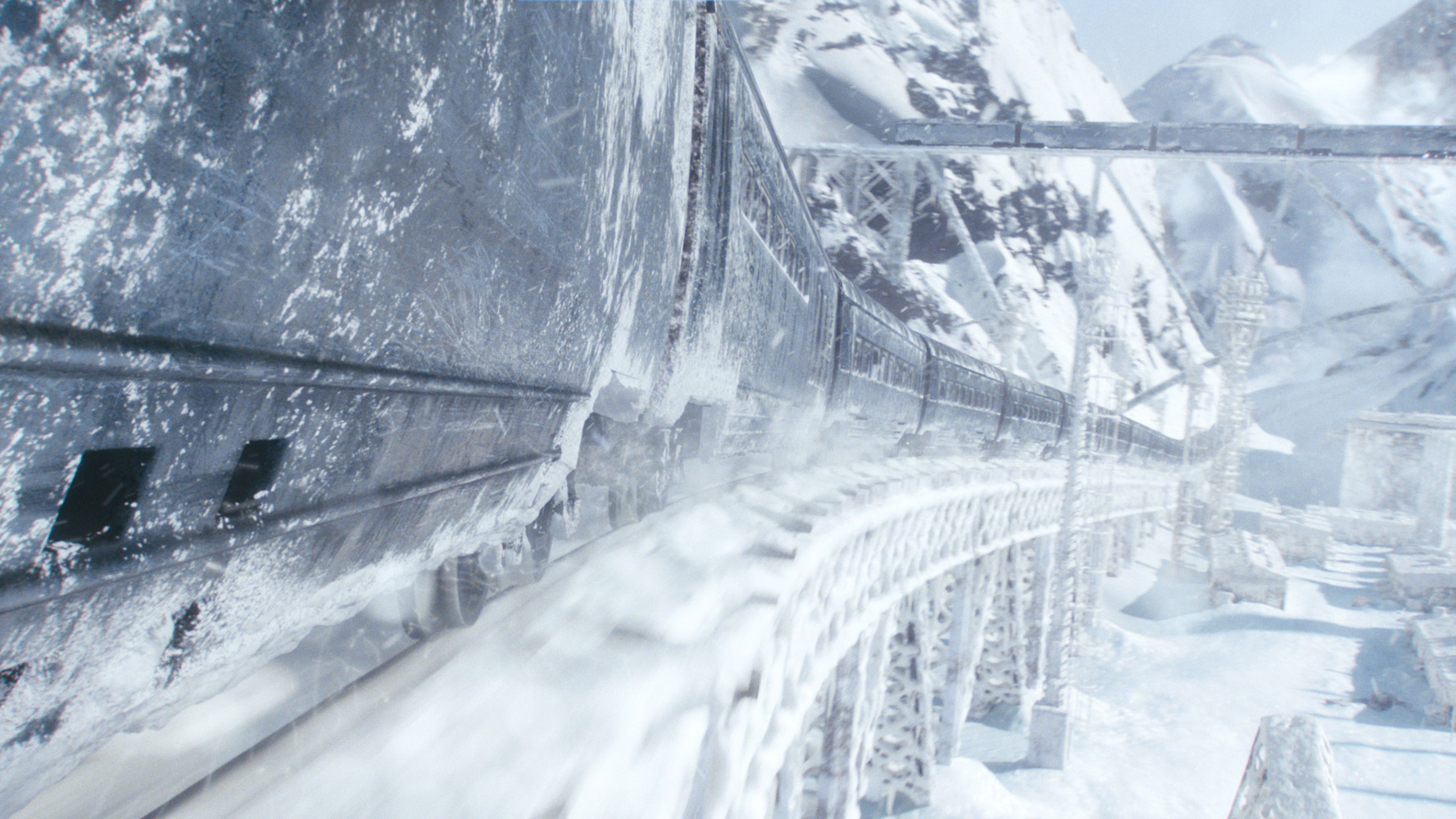
The year is 2031. Seventeen years prior a worldwide attempt at cooling the earth to prevent global warning failed, plunging the planet into freezing ice. All infrastructure, culture, and civilization is now lost in an icy expanse, with the exception of a train that continuously circles the globe. In this train are the remains humanity, structured into strict classes where the rich dwell in the train’s front, living off the poor and ratty unfortunates who dwell in the train’s tail. 

Snowpiercer1

Clearly such a story is shot through with allegorical implications. The director, an ever innovative Korean named Joon-ho Bong, acknowledges this by fully embracing the representational world, sweeping us away with the completely realized costumes and detailed grit and grime, all captured by claustrophobic camera work. The people living at the back of the train daily suffer from injustice. As they become more desperate they begin a revolution, breaking out of their guarded tailend, led by a stern faced Chris Evans, a lively and witty Jamie Bell, and a couple of other motley ordinaries on a last-ditch effort to claim the engine and confront the owner of the train. As they proceed up the train and its compartment’s are opened one by one, they are met by the bureaucrats and their armies of axe welding soldiers, commanded by bizarrely costumed but perfectly convincing Tilda Swinton.  The resulting conflicts are brutally violent, blade on flesh and metal on blood, like so much of our civilization’s history. 

Snowpiercer2

The story, like the train, plunges ahead full throttle. It delights in surprising us as compartment after compartment are opened by the rebels revealing deadly twists and surprising turns. Main characters are killed off and minor characters become unexpectedly important. And as the movie hurtles towards its conclusion, we are left on the edge of our seat. How will it end and what vision of the world will it leave us with?

The train itself, containing all this is left of this world, becomes a compelling microcosm of the film’s view of reality. The train, and with it, all life, resides on a fixed track, hurtling along at a breakneck speed making an outside existence impossible. Its inhabitance focus on their misery or the distractions of their life but the few who glimpse the outside of the train see only hopelessness, a canvas bleak, chilling, and inescapable, who's inhabitants are “dead, all dead.” Ever and always the noise of the locomotive can be discerned, a daily reminder of its inhabitants vulnerability, sometimes grinding in the background, sometimes clanging and shaking.

Snowpiercer3

It is a bleak and despairing worldview, but it does take keen interest in its inhabitants, their existence, and their reasons for life. We could argue that the story paints a picture of a cruel God, grinding away at an eternal engine, pushing his cold doctrine through a brainwashed power structure.

But the film’s ending succeeds in surprising us, with both a twist and a heart. Listen closely as the population’s only hope tells a story of his people’s early days. Recognize the sacrifice and personal cost in that story and see how this heart of compassion for the least of these becomes a key to the climax of the film. Compassion, in a world as depraved is what is depicted here, holds a gleam of potential light and with it, hope. 


These Losses Spark Longing

This week a dear friend left town, returning to school in the States. Last week, another close friend left Calgary to enter ministry in Vancouver. When these beloved gems of my life leave, it is like I am experiencing their death in miniature, for although their departures are not permanent, their loss is still felt. A funeral dirge, however dim, is still heard.

These partings can spark longing. Both friends left to pursue things that I also yearn for, school and West Coast culture. But my season for such things has not yet arrived, so I press on, shaking off any burdens of attachment, relieved to be allowed to focus on the pilgrimage. My hand is to my staff and, like Frodo, I move forward on my quest.

image.jpg

But almost as these words leave my mind, I pause to reconsider the analogy. “Hand to the staff” is not the phrase from scripture. “Hand to the plough” is. “I will follow you, Lord” said the man in Luke 9, “but let me first say farewell to those at my home.” It was then that Jesus said “No one who puts his hand to the plough and looks back is fit for the kingdom of God.”

I see that my imagery need realigning. A plough is different than a staff.
A plough does not ignore the barren ground, but revitalizes it, digging deep into the earth. The ploughman’s hands bare their tool with blisters, skin always broken and always healing. He is not content to pass by hardship, but turns and circles back, digging up the rocks and boulders, grappling, wrestling with the land given him.

And so there is work before me. Sweat will be required and weariness will be worn like a honoured weapon. But the ground needs breaking before it can be sown. The land is not mine, yet here I will dwell, readying it for the farmer’s seed and praying for harvest rain.

Dawn of the Planet of the Apes (2014)


Summer blockbusters seam intent to satisfy crowds looking for low mental output and high octane thrills, but rarely do they leave the viewer with anything more enduring than a headache and more thought provoking than a love triangle. And so summers find contemplative viewers in small theatres seeking independent jewels. But when these viewers wants to talk intelligently about movies to anyone outside of the five audience members present at the indie theatre, Transformers 4 and Sex Tape don’t offer much fodder. But just when such hopelessness confronts us, along comes a smart blockbuster like Dawn of the Planet of the Apes, a film popular, exciting, and thought-provoking.

Apes1

This movie is not called Dawn of the Planet of the Humans and Apes, so from its very title we know that things do not look well for the humans who have survived the devastating simian flue. The evolved ape community will rule and our race will be exterminated. We just don’t know how, so we watch the nervous interaction between the new ape civilization in the Redwood Forest and the struggling humans in ruined San Francisco with incredibly high stakes. Minor decisions are being made and any one of them could be the spark that sets the inevitable bonfire of war alight.

This simmering tension is sustained by a musical score that, like the film, is both interesting and heartfelt. The cinematography is not content to to let us just sit back and partake in the action, instead it throws us in headfirst with angles that surprise and engage the viewer. And it's a major accomplishment that we grow to care for and understand the apes as equally as the film’s humans. Part of this is due to to the completely believable worlds that are built, both the rising ape culture and the ruined San Francisco.  And a large portion of credit goes to the astonishing work of Andy Serkis and his fellow ape actors. The audience develops a deep emotional resonance with their civilization but the remaining humans are not ignored. Instead, the uniqueness and preciousness of human life is acknowledged, especially in light of the oncoming disaster.  One might argue that there is less depth to the human characters, but I would say that since we are unfamiliar with the apes, the extra time spent with them is well proportioned. 

Apes2

Watching this movie will inevitably spark deep discussions. I would suggest that there are two conclusions we can walk away with. The first is the importance of a rooted understanding of what makes someone human. If humans are not made in the image of God, ethical decisions between apes and animals and lower life life or higher life loose their footing. But as sketchy as this ground is, I think Dawn of the Planet of the Apes deserves more praise than criticism for its ontological understanding, if we suspend our belief and acknowledge that the apes are humans. And that is the second conclusion. Fo even in an ideal community like that of the apes, war is inevitable. Someone is going pick the forbidden fruit, disobey the given rules, and fire the shot that will begin the collapse. The minor moral choices we make have great weight because their consequences are brutal.

Finding a movie that strikes us with these truths in such a fresh and thought provoking way is rare. Coupled with a story that is thrilling, special effects so effortlessly believable, and a world rendered with both explosive terror and and quite sadness, we have a summer blockbuster to be proud of. 

Reflections on my Parent's 25th Wedding Anniversary


Watching archival footage through the eye of a home camera, they were young and handsome. Witty and joyful. Pleased and expectant. Their commitment was pure and radiant were their faces. I have hardly seen a happier and handsomer couple.

“In sickness and in health” says the liturgy and sickness did indeed mark the majority of his days, hampering his academics, his social life, his ministry to the church. But ours is a home of hard-won happiness and their sacrifices were sacrifices of peace.

And so we stand now on the flip side of 25 years, years composed of days and marked by careful steps, regarded conduct, and content with quite contemplation. Their quiver, this side of the battle, is not marked by successes to boast in, yet it is full none the less.

We, their four, still live in a home built by “exhaustions nominating peace.” We are marked by the fall that grinds way at them too. But greater is the joy, a joy that ripples off the mountain valleys like laughter. For we are an offspring of sacrifice and the Spirit. This is His doing, and it is marvellous to behold.

Happy 25th Anniversary Mum and Dad.

Tracks (2013)

This review was originally written in June 2014. The images are from the film and are not my own. 

People are conflicting, confounding, and confusing. Our interactions with them reveal a fundamental problem with our very core. Some of us try to ignore confronting this problem by distractions. Others bury it in resentment. A few take a more desperate action, what some might call crazy but what could actually be an honest response to the predicament. Robyn Davidson (Mia Wasikowska) was one of these people, a spirited young Australian who was inspired and driven to do a feat that had everyone shaking their heads. Her goal: walk across the Australian outback by herself, using four camels and accompanied only by her dog.

Of course, a film like this has to be based on a true story, first recorded in a 1978 National Geographic article and later a book by Davidson. And like any episodic travel film, there are challenges that come with such a territory. The film tackles these challenges in a frustrating mixture of half heartedness and visual creativity. The half heartedness came from attempting to check off the boxes we expect in a film about such a wilderness journey; Robyn loosing her compass, or being attached by the wild bull camels, or getting to know the local aboriginals. Another challenge is the recurring scenery, but here the photography prevailed, finding creative ways to show the austerity of the desert, focusing on its shadows, its negative space, its heat and its whiteness.

Tracks1

But even if this territory felt flat, the grace and grit of Mia Wasikowska’s character holds and sustains our interest. Robyn is fascinating. Why would this slender willow of a woman tackle such a harsh landscape, peppered with such harsh people? Wasikowska’s face holds continued appeal as she attempts to read the people and environments she throws herself into. We are aware of every slimmer of loathing and longing that battle within her.

For it is people that she is trying to escape from, almost to prove that she is tough enough to be without those who betrayed her in the past. She tries to avoid those who pry into the curiosity of her journey. She shuns people who follow her, seeking to be alone with her animals But Robyn soon finds that a journey like hers requires the support of people. People to her train her camels, people to guide her during the roughest territory, and people to provide funding. And it is because of their contribution to this funding, National Geographic sends along Rick Smolan, played with a charming awkwardness by Adam Driver. Robyn dislikes him, for genuine reasons. He is pries too much and nearly ruins sections of her journey. He is annoying but can not be ignored.

Tracks2

In the end, when the animals she loves dearest are taken from her, Robyn cracks under the weight of loneliness. The arid, white desert that she wanders through is empty and void of humanity and the few humans she encounters treat her like an oddity. As she continues her solitary quest, a sort of shock sets in. In one scene Robyn sets huddled under the blackness of the outback, her terrified eyes and sunburnt face illuminated only by her fire. Out of the darkness comes a stranger, talking cheerfully yet unceasingly, his face shrouded in a racing helmet, bright as clown’s. “F*ck man, it's cold out here” he drawls, warming his hands by her fire. She is terrified of his harmless appearance and as he leaves his statement rings with truth. This world and its inhabitants are cold.

Tracks3

And yet there is something that can overcome this coldness and loneliness that accompanies it. There is a kindness that breaks through, persistent despite Robyn’s retreat. Strangers, themselves alone in this wilderness, take her in and offer her fellowship. Others, putting their own needs behind, guide her through the toughest sections of her journey. And one in particular goes out of his way to provide for her needs and celebrate her successes. It is this kindness that stands out against the harshness of the world and reveals the glimmer of hope still offered.

Fresh Creativity

Sometimes all it takes to break a creative block is a new app and a creative partner. I had been away from home for a month and a half, returning to my family on a beautiful spring evening. I was surprised to see how warmly my little brother responded to my presence. He's just entering the teenage years, which can be tough but that night he didn't stopped talking to me about anything and everything. He's a pretty creative kid and on a walk with our sisters I pulled out, for the first time in a while, the multiple exposure app Average Cam Pro.

The design of the app needs a lot of work, but the concept is terrific. You control the number of exposures and the time between each exposure, resulting in an image that is layered and jagged and can be controlled by movement to stunning effect. Instagram user Kym Skiles has inspired me with her images for some time now.


We had a blast and came away with some terrific images, but of all the ones we took of our sister, this one takes the cake...and my brother took it, putting all of my attempts to shame! I'm pretty proud of him (and slightly jealous)! 

Since that evening I've been playing with the app quite a bit. I found it a refreshing way to see colour, texture, and form anew.  Enjoy these images and expect to see more in the weeks ahead!


Godzilla (2014): A Capsule Review

This review was originally written in June 2014. The images are from the film and are not my own.

Genre films can be so boring. Superheros, bumps in the dark, cowboys pointing guns, they have become so much of a template that Hollywood can spit them out with more fanfare and twice as much sticky ooze as EasyBake cooking projects from my childhood. As result, moviegoers looking for visual creativity and thematic interest have learned to look elsewhere. 

But now and then we come across a creative visionary who takes this cookie cutter predictability and turns it into a challenge. In such a chef’s hands a genre  film, by very nature of its familiarity, can be used to say interesting things in interesting ways. Enter indie film darling Gareth Edwards. Entrusted with a Hollywood budget, we have a Godzilla to take note of.

Godzilla1

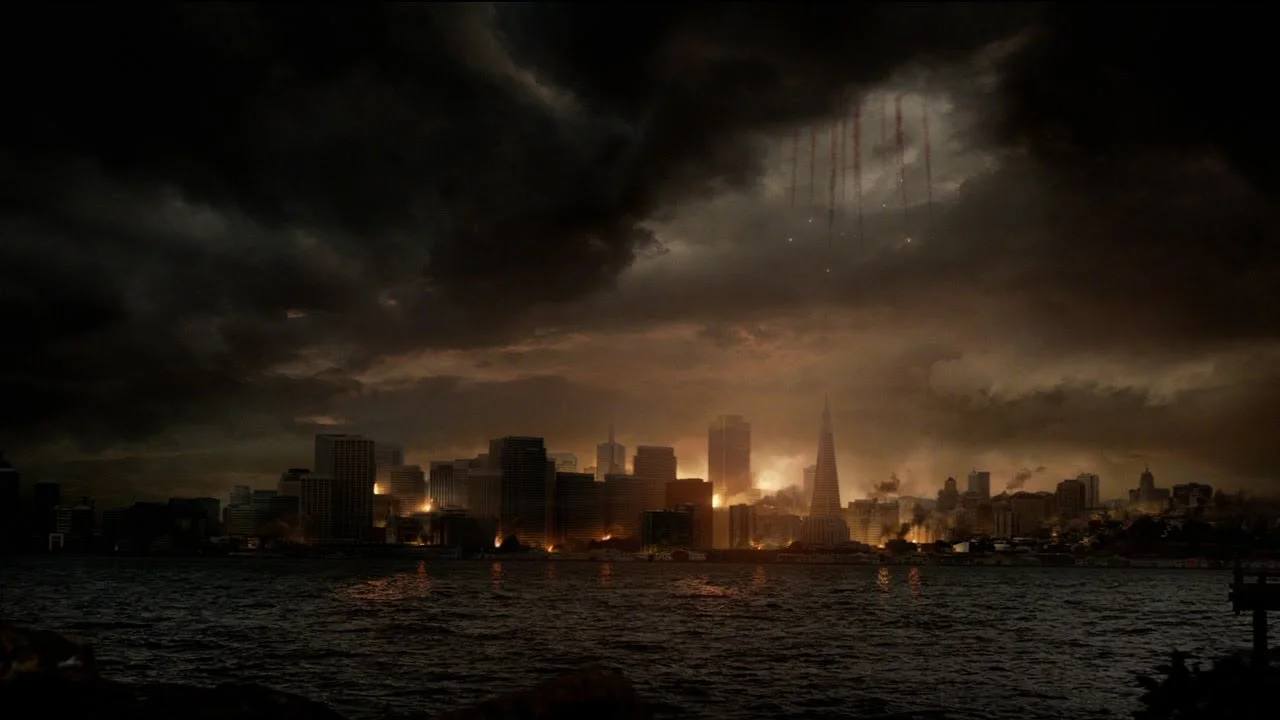
There is a creativity in this film that was unexpected. It contains a storyline that includes all of the major points (MONSTER FIGHTS! NUCLEAR SECRETS! CITIES DESTROYED!) but it had me guessing how he would get us there for the majority of its duration.

But even more appreciated was the way the camera introduces us to its world. There is repeated theme of windows and reflections - characters observing tragedy through a literal window, a window like frame accenting other scenes, and the window of a television used to provide a new angle on the action. But the camera is also aware of the vast space of this canvas and uses this space to full effect. A chameleon crawls on the jungle floor, a foreshadower of a much larger scaly creature. The camera pans beachgoers on vacation before it leads our eye to to the destruction in the distance hills.

These clever entries lead us directly to the “holy sh*t!” moments of scale and terror, making such moments all the more memorable. Equally impressive is the colour language at work (the Dante like scene of the paratroopers descending into the dust and ruin being a favourite).

In addition to being creatively realized, this movie also uses the familiar themes of a monster film to explore serious questions on man’s seeming power to control things. Their is a careful balance at work. Military power is shown to be necessary and important and yet futile in the face of such higher powers, much like the way such power is depicted in the Old Testament.

Godzilla_2014_Official_Main_Trailer_-_25.png

The portrayal of Godzilla is of a great being to be feared, that leaves your city in tatters but, more importantly, alive, that conquers enemies at great cost to himself, leaving you humbled with the knowledge that, with such a creature alive the deep, your are never quite safe, never quite in control. It’s a biblical image that is rare to find in the blockbuster. There is a sacrifice and a brutality woven into the nature of universe.

It’s a shame that the human characters are so flat compared to such crackling brilliance. If we had something to latch onto in them this would of been a blockbuster for our generation.

Reflections on Babette's Feast (1987)

These reflections were written in June 2014. The images are from the film and are not my own.

Growing up in a Christian community, the majority of the stories that were told to me dealt with the results of the church and the world crossing. The contrast was always impressive. Sometimes the good character would become corrupted, often the worldly character would convert, but occasionally the worldly character would leave the church unchanged and the good character would remain in the church, having learned the importance of staying pious.

Babette's Feast is a fable-like story that explores this topic with greater nuance then those childhood morality tales. But it also addresses a second more subtle contrast of the church and decadence. What happens when worldly luxury meets humble faithfulness? What is the roll of such artistic extravagance in the church?

babette2.jpg

This film touches on these issues and more. It gets many things right, is lit with an ordinary beauty, and explores important themes with such balance that there is room for many essays. "There is a steady gathering of emotion, a sense of a larger truth being touched."

It's central message is that summed up in a quote from the film. "Grace, my friends, demands nothing from us but that we shall await it with confidence and acknowledge it in gratitude. Grace, brothers, makes no conditions and singles out none of us in particular; grace takes us all to its bosom and proclaims general amnesty."

71dfzVhL1JL._SL1500_.jpg

But what that quote misses and what is only lightly touched upon in the film is the cost that such grace requires. A cost that Babette herself freely gave and cost that was given for the grace that we so freely enjoy. That cost begs us to consider when and how such decadence, in life and in the church, should be enjoyed.


The Secret Life of Walter Mitty (2013): A Capsule Review

This capsule review was originally published in May 2014. The images are from the film and are not my own.

Last summer when the trailer for this movie arrived I watched it on repeat. It was perfect. Stunning creative shots set exquisitely to a Monsters and Men track and an ending at the car rental shop so funny my brother and I laughed again and again (I still think it's the funniest moment in the film). If I could have framed that trailer I would have, but part of me knew that such unabashed devotion only resulted in outstandingly high expectations.

the-secret-life-of-walter-mitty-movie-still-11.jpg

Now that I finally got around to watching the film the unusual cinematography that the trailer exhibited remains its major streangth, alongside its creative use of typography. It's fitting that the visual elements are so strong in a film that celebrates the value of photographer's image. This, combined with the mostly unified soundtrack (thanks Josh Ganzoles) and the rugged Icelandic landscape, kept me happy for the film's duration. But the movie as a whole failed to graduate from good to great for three reasons.


The storyline felt slapdash and predictable. A plot that moved from New York to Greenland and Iceland and then back to New York would make sense. But a plot that does all that, then adds a backpack trip to the Himalayas and a segway in LA (for the purpose of reintroducing a minor character), finally returning to New York to neatly sum everything up felt a tad complicated, especially when the eventaul ending felt so predictable.

the-secret-life-of-walter-mitty-trailer-3-2013-ben-stiller-sean-penn-movie-hd.jpg

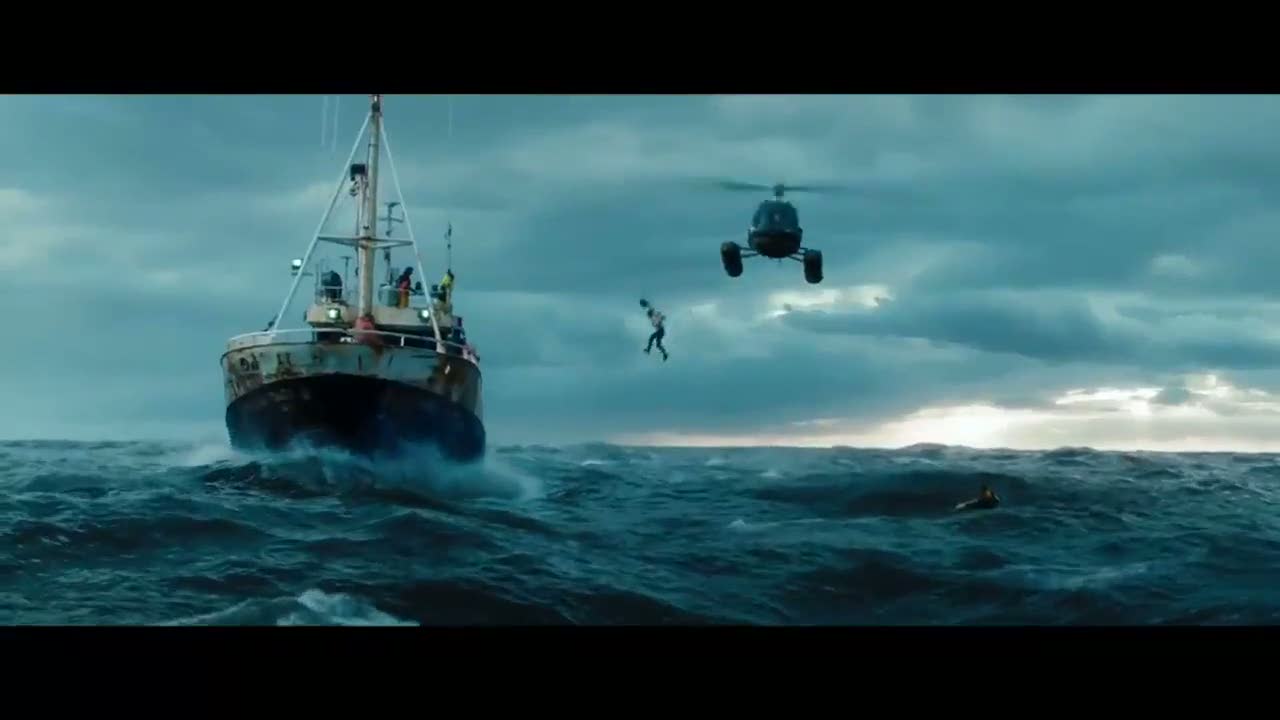
The film's believablity was also hampered by an inconsistent reality. I enjoyed Walter's daydreams. The cinematography blended so them seamlessly with reality that at first we aren't sure just was is happening. (Did he really just insult his boss's beard so brilliantly?) I particularly enjoyed the battle in New York's streets that poked such good natured fun at our modern obsession over superheros. But when the story changed from daydreams to real adventures, moments like a shark battle in the Arctic Ocean cast this supposed reality into a dreamlike state - which would have been fine if the point of the story was that Walter was now transitioning from solely dreaing about adventures to actually doing them.

Which brings us to the point of the story which was muddled by an uncertain and unarticulate message. I think it's point was that we were supposed to go out and chase our dreams. But maybe it's saying that all it takes to get the girls and stare down the jerks is to have a tanned face and a beard from epic mountaineering? Or that having Iceland on your resume along with skateboarding skills and the skill making descisions to join a Tebiatan football game after hiking all day will get you success in life? It did have something do to with being the hardworking ordinarily employee (as long as you remember to enjoy the moment rather than always photograph it). It is hard to be profound when you have nothing profound to say.

The-Secret-Life-of-Walter-Mitty.jpg

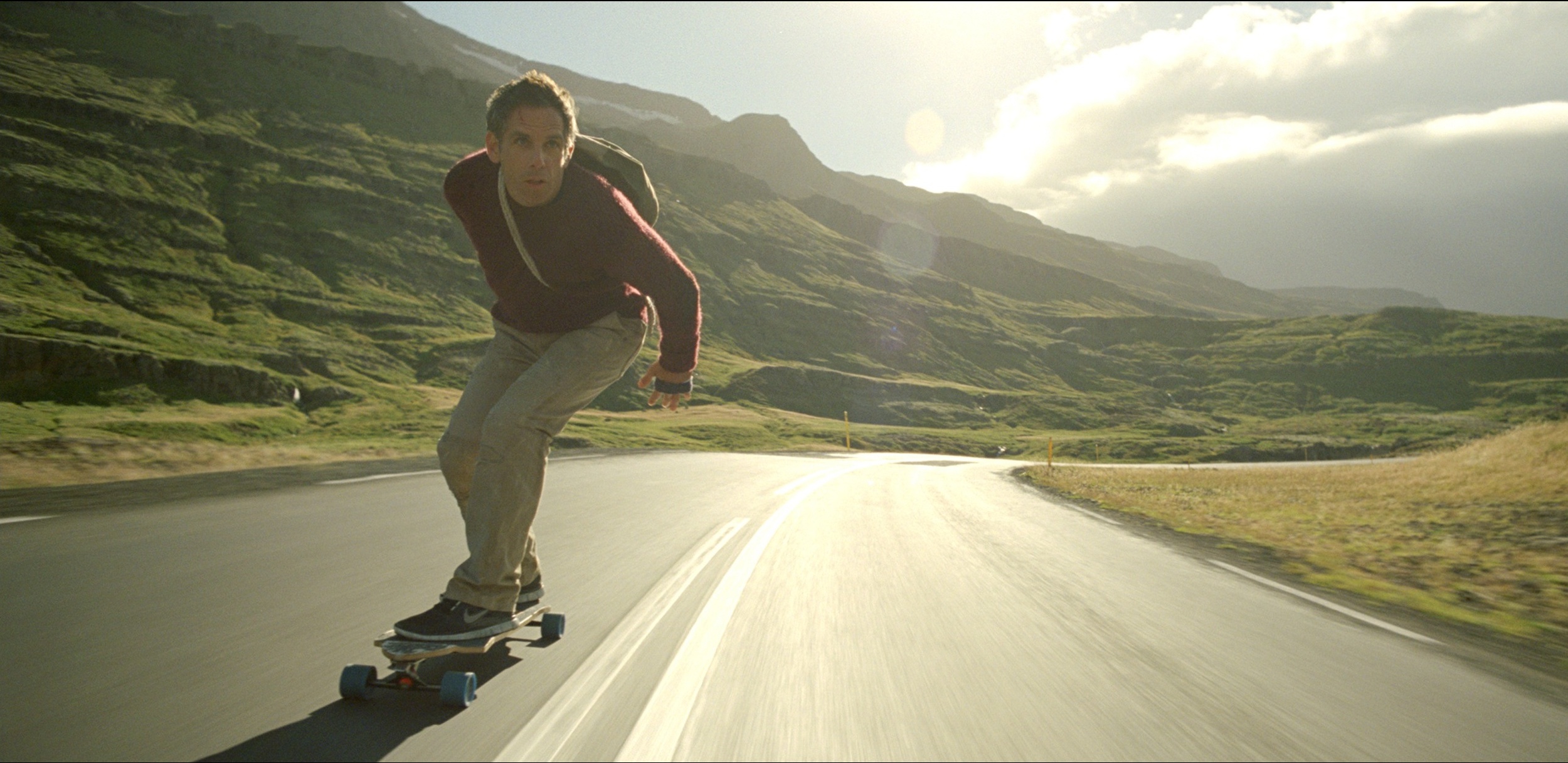
In the end, the film would have done better if it had tried to do less. Like longboarding down an Icelandic road, this is a fun ride with many pleasures. I enjoyed watching it. But its efforts at trying to say something leave it in the dust of so many other films that say such things so much better.

(And no Icelandic kid would trade his brand new longboard for a ridiculous toy from the 80s. Please.)

Lenten 2014: A Photo Journey

I did not grow up celebrating Lent. Advent, yes, but Lent had Catholic connotations wrapped up in it. And while I think it would be healthy for someone coming out of Catholicism to abstain from Lent, for evangelicals unaccustomed to such discipline it can be a sobering exercise, preparing one's heart for the coming Resurrection.

This year I decided to do something unusual. I would fast from using colour in my images. Switching my iPhone's camera from colour to black and white was easy with iOS 7. Finding a photo to post (almost) everyday was the greater challenge. Although the discipline made me aware of the shadows and forms everywhere in our world, it was easy to become repetitive.
Another challenge was finding texts to match the images. Malcolm Guite's beautiful series of sonnets for the church year provided much inspiration, as did BIOLA University's Center for Christianity, Culture, and the Arts Lent Project. Of course, scripture was a constant guide and I used a stripped down version of the seven last words of Jesus for one week. (Click on the images below and then hover over them to view the words.)

The effect on my feed and my heart was one of subtle sadness, a weariness and watching that suited life in a fallen world. But as the days went on there grew a steady, constant hope. The Resurrection was coming. All things (including colour) would be, and will be, restored. 

The Mill and the Cross (2011): A Capsule Review

This review was originally published in April 2014. The images are from the film and are not my own.

I was introduced to this film over a year ago and knew then that I looked forward to returning. But the question was how long to wait? I didn’t want to rush it. But I also knew that this movie would be the perfect fit for Holy Week. So on Holy Saturday I turned down the lights and pressed play.

I am now more familiar with the painting this film brings to life so effortlessly, particularly its lighting. Its costumes and props are so rough and lived in that their foreign realism shocks us.

MillandCross1

The theological and artistic heart of the movie is the intersection of ordinary people’s lives with the cruelty of the world. We see this intersection graphically when the life of a young couple is ground to a searing halt after the man is brutally torn from his wife and lifted up to die while on their way to market. We see it subtly in the crows, ominously and repeatedly visible through the window of every house, particularly Brugal's as his young wife cares for their rowdy children.

But nowhere is the contrast more obvious then when these smaller images of the divine morph into an anachronistic representation of the ultimate intersection - the passion of our Lord. In the history of art anachronistic paintings of the crucifixion are common but we see them less in our film driven age. So in the film, when Judas betray Christ by visiting a cathedral's confession room or the condemned thieves meet with a priest before being dragged to their crosses, it’s like cold water to the face. And it reminds us that the world Christ came to save is our world; in this movie, the Flemish world.

MillandCross

In the film Christ’s crucifixion is given a weightiness, most notably in the scene when the miller, representing God, “parts the clouds” by pausing the windmill and with it the scene below him. But when the gears resume their turning and the people their moving and the world its cruelty, I longed to see some glimmer of the resurrection. There lies Christ’s body in a grave, holes on his feet. There is the sun, welcomed after the darkness and violence of the night. There are the people, moving on, dancing, showing Christ in the way they care for their offspring.

There is only one difference. In the background this time there are no crows.

Noah (2014)

This review was originally published in March 2014. The images are from the film and are not my own.

One of my earliest memories is my dad reading to me from Ken Taylor's Bible in Pictures. The images seared in my early memory were far different than the cartoon images in other children's Bibles. They were vivid and realistic, men with muscle and woman with grace. These images were my earliest encounter with the Noah account and one particular image stood out as I watched Darren Aronofsky’s Noah. It was of a wooden ark, tightly sealed, mounted on jagged, painful rocks. Water poured from the sky and gushed off the these stones while desperate men and woman clung on for life while others slipped into the encroaching waves.

Any time Hollywood takes a beloved story and illustrates it on the big screen, scores of angry fans of the book will tear apart any time the adaptation commits infidelity to the text. But if such is the case for a work of fiction, the response is intensified when someone tries to adapt the Bible. It's disappointing that there is such backlash from Christians who have historically had a close relationship with the arts, especially religious art. So it's no wonder recent adaptations safeguard themselves from such response by creating tame and boring films of biblical texts, like the recent Son of God.

So I was rather intrigued when it was announced that Darren Aronofsky was directing a large budget version of this beloved story. Aronofsky is first and foremost an artist who is bound to use his greatest gift, his imagination, in telling this story. And, contrary to what many devote Christians are raving against it, Aronofsky is treating the text with great seriousness, both in details, like the measurements of the ark, and the human themes contained in the account.

Noah-2027-HD-screencaps.jpg

Immediately apparent is a distinct visual style. The antediluvian world is depicted as far different than our own. Barren, expansive landscapes are paired with crude ancient clothing, architecture, and artifacts. Of course Aronofsky gives us the expected stunning visual moments that draw us, the audience, in with anticipation - animals surging towards the ark, water springing from the ground and pouring across the earth. Less expected but equally appreciated were the small imaginative details like stop motion flow of time passing while the creator creates and the reoccurring figure of Cain killing Abel as a symbol for man's propensity to violence.

But these broad brush strokes also lumbered, much like the ridiculous and unnecessary fallen angels turned rock giants. Part of the challenge is that this story is so familiar and linear that the director almost has to add extra drama, drama that ultimately weighed down the flow of the film.

Aronofsky’s is deeply concerned with the humans that are at the centre of this story, particularly Noah and his call to obey a God he doesn't understand and isn't quite sure he hears. This was a clear departure from the text in scripture, where God’s message to Noah is explicit and allows many opportunities for the rest of mankind to repent and take refuge in the ark. But this departure results in a fascinating dilemma to materialize. Man is pictured in this film as fallen to his very core, both in his actions and the intent of his heart. It accurately depicts the root of the Fall as wanting to be like God and refusing to allow His word to rule.

Russell-Crowe-Noah-2014-Wallpaper.jpg

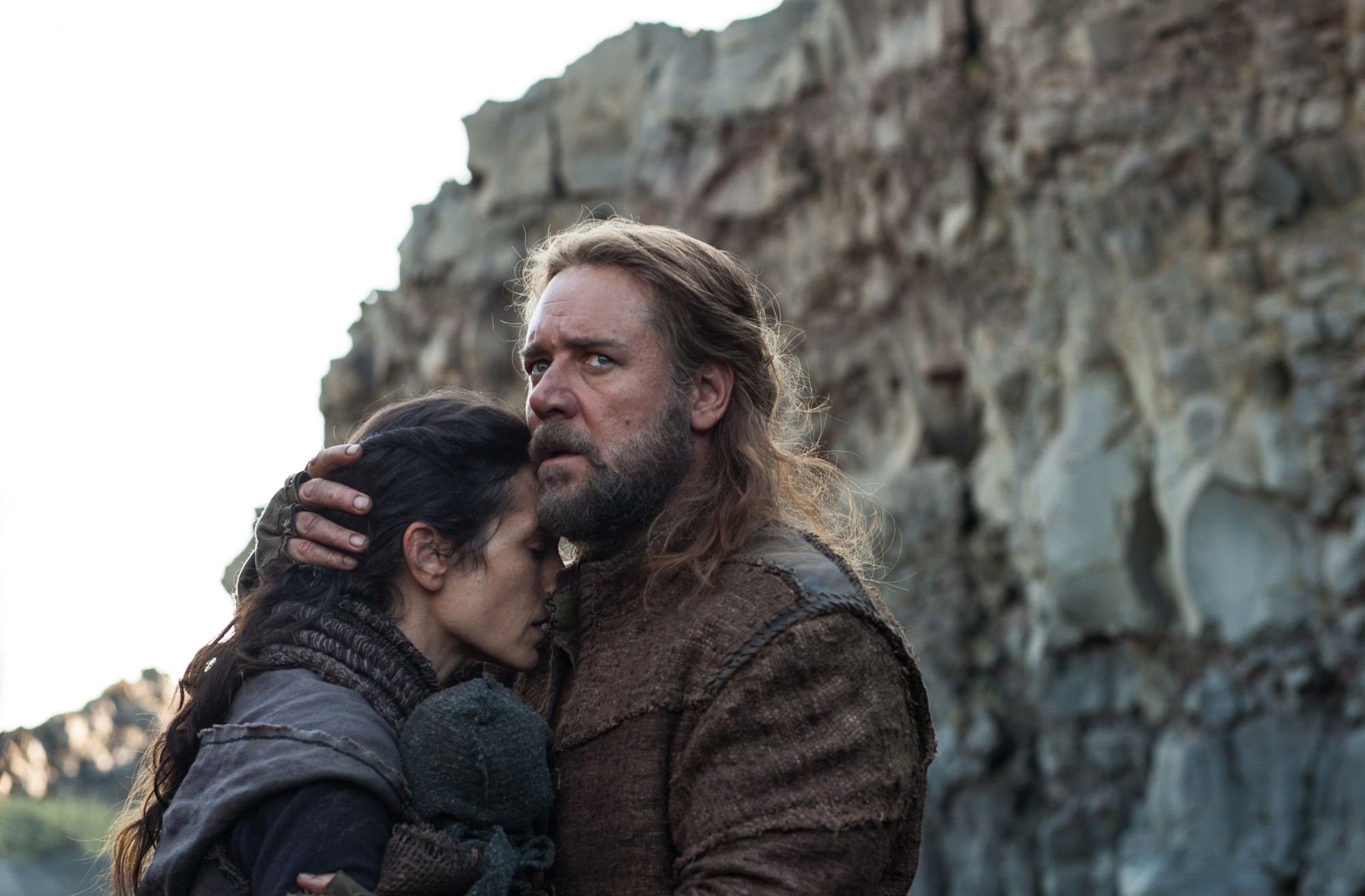
At one point, Noah, having seen the extent of human evil in the hoards that surround the ark, comes to realization that this same fallen nature is rooted in him too. His wife insists that he and his children are good, listing off their attributes until Noah interrupts her. “If their lives were at stake , wouldn't you kill others for them?” In coming to this honest realization of his personal propensity to evil, Noah (and his screenwriter) have been more accurate as to the state of humanity then many other recent films.

Noah is left with an intense internal dilemma. Why has God chosen him and his family to continue to live? What has made them so special when the Fall as ruined them too? Don’t they and their innocent offspring deserve death, the same death brought upon their neighbours by the waters around them?

Aronofsky is creating this movie from the perspective of a Jew-turned-athiest, and he doesn’t give an answer. He hints at a possibility through a drunken, naked, and broken Noah on a beach, restoration and reconciliation through new life, and the unspoken promise of a rainbow pulsating from above.

Noah

But it is through redeemed eyes that we look back on the story of Noah, seeing grace from judgement offered through one man. We see a God who himself shut the door of the ark, giving many plenty of time to get onboard. We see a family, themselves just as broken as their neighbours, offered mercy through a second chance but we also see a means for this grace to appear. Noah is allowed to live, but his wickedness did not go unpunished. “By faith Noah…” says the writer of the New Testament book of Hebrews. By faith he trusted in the God who saved him and by faith the punishment that he deserved was passed on to another, an innocent man, the God-man made flesh, Jesus Christ. That is my answer to the very important dilemma put forth in the film.

So is this movie perfect? Far from it. Is it an artistic accomplishment? Absolutely. It engages an age-old text, raising serious questions that will result in fascinating discussions; therefore it deserves be seen.

The Grand Budapest Hotel (2014)

This review was originally posted in March 2014. The images are from the film and are not my own.

Every since seeing Moonrise Kingdom in a small theatre in 2012, Wes Anderson’s films have always held a certain magic over me. His minutely crafted details draw me in, but I return for the character’s honest and painful journeys, reminding me of the joys ever present in this life.

Wes Anderson always creates artificial or nostalgic worlds that are tucked away in their own space and time, connected to our world yet entirely their own. By its very title implying old world Europe, The Grand Budapest Hotel lets you know that this story will accentuate these traits. Yet Wes eases us into this faraway country by the use of not two but three prologues, each in a separate aspect ratio. It is a time very different than ours, where Andersoneon visual symmetry and character quirkiness feel entirely natural.

And so the hotel and its surrounding landscape, like a luxurious visual pop-up book dusted with icing sugar, is the ideal medium for Wes to perfect his signature style. Visual elegance is matched by characters so pitch-perfect that one false step would ruin the illusion - but this delicate pastry of a movie is in the hands of meticulous master and there are no false steps.

Grand Budapest1

A good portion the fun is its wound-up mechanical clock of a story involving train rides at night, tramways up snow covered mountains, luge sled chases (in stop motion) and an evil villain (William Defoe) with so many giant rings that his fingers are an ever present brass knuckle. The flavour is that of a Tintin adventure and the joy of the action is equaled by the joy of its humour. Wes Anderson’s jokes are always character driven and the characters here are numerous and in perfect step with each other. It's as if Wes gathered a "whose who" of old and new Hollywood players, impeccably outfitted and moustached them, and let them play their best, serving the story rather than themselves.

Ralph Fines plays M. Gustave H, a vain concierge, egotistic in his ever present service, dedicated in detail (and body) to every guest at his hotel (which all happen to be old, rich and equally fuelled by flattery). One of these guests, Madam D. (Tilda Swinton as her future self), is murdered in her mansion, setting off a goose chase involving fortune, a old-master painting, henchmen in black and the (somewhat) innocent against the (purely) evil.

Budapest2

But just Madam D.’s fear foreshadows her eventual murder, an approaching darkness grows in the background of the picture, visualized by SS soldiers at checkpoints and the decay established in the prologue. This darkness announces its permanent arrival through several unexpected and grizzly deaths. This may be a fairytale world, but it is rooted in a real and tragic history.

This darkness helps balance what would otherwise be almost too sweet to swallow. Much like the film's tiny pastries that hid iron weapons, this confection of a film contains serious themes under its delicate wrapper. Guestave H., through his lobby boy in training (Tony Revolori),  undergoes a journey from vanity to humility and sacrifice. His protégée, Zero, realizes that against these dark tides of Nazism and socialism there is real love to protect and cherish - love for his fiancé Agatha (Saoirse Ronan) and his now elder brother Guestave H. Zero, who arrived in Europe with “zero” family, has found one. And even if tragedy takes them, his memories of them will leave him content.

film_review_the_grand_budapest_hotel_89664785.jpg

But there is hardly time to catch one's breath to let these themes sink in, which is perhaps why this volume doesn't rank as high in my books as Anderson’s other, more poignant, stories. And does this dark undercurrent lend itself to despair? Is there a certain sense of cynicism - the knowledge, given through the prologue before the story begins that as grand and elegant and beautiful as this Europe was, it would soon implode to death, decay, and depression - a grim riper, hiding in the dark shadows with socked feet? Perhaps, but one might argue that this is a realism that gives this visual delight its staying power. And lest we worry that subsequent times were devoid of beauty and humanity, Wes Anderson's other films should serve to remind us that joy, sorrow, repentance, and delight - life itself - will continue.

Philomena (2013)

his review was originally published in January 2014. Images are from the film and are not my own.

Last week a friend and I watched Philomena, a BBC film about an elderly Irish lady who has kept hidden for 50 years the secret of her pregnancy as a teen. A group of nuns bring her into their abbey to deliver the baby, but in penences for her sin and their medical assistance she is required to work for several years to pay them back and her baby boy is adopted by an American. Fifty years later, Philomonia opens up to her family about her past and her story is told to Martin, a once prestigious journalist who had a falling out with BBC and is now struggling with where to go next in his career. He rather reluctantly picks up the story and accompanies Philomenia on the search of her son.

This is essentially a "human interest story" but it is a brave one, diving into incredibly sensitive subjects, yet uplifted and sustained by the character and humour of its main actors. Judi Dench plays an ordinary person with a dark story of sadness running through her memories like a black cord. It's a testament to the grace given her that the evils she suffered don't inbitter her. Instead she is lovable, kind, and generous in her estimation of others.

Philomena1

The storytelling is not perfect, at times rushing moments that could have been quite moving had they more room to breath. Although the transition into the backstory was a rather creative shot, the rest of the backstory could have been more creatively integrated. Several aspects of the story felt a touch contrived or simplistic, until you realize that it is based on a true story. I wondered out loud if this project had two screenwriters and I was correct.

My response to the story was also complicated by my relationship with the Catholic Church. As an evangelical it was easy to categorize the evils and attitudes we see in the nuns as a Catholic problem. And I couldn't help but notice the lack of repentance or guilt Philomenia had over the orginal affair. It's as if the character herself adopted the stance of the filmmakers.

philomena-movie-still-4.jpg

But to focus on those issues is to miss the point. This is an engaging story driven by powerful characters and their interactions. Especially notable is how this movie contains so many honest conversations betwen the sceptic and the believer. Martin is an atheist and Philominea has kept her Catholic belief. She continues to keep this faith dispite the fact that as the story progress it is her faith, not his, that ought to be tested. Instead of becoming more bitter towards the wrongs that were commited against her she grows in grace, both towards her persecutors and in how she answers her sceptical friend, a true testament of the grace of her redeemer.

Philomena3

And it is ultimately this grace, this forgiveness offered her, that she can extend to her tormentors. And so the simple Irish granny, fond of croutons and tootsie roles, can offer something that the Oxbridge-trained man of this world can not - forgiveness. This forgiveness does not from her, but from Christ,  who's image she places on the tomb of her son.

Yes, this film is not perfect. Yet even the stories we tell, something as inconsequential as the cheap romance stories that Philomena reads, have wisdom. And, like this story, they can reflect the truth and beauty of the Story-weever himself onto the plain face of his bride. "And I never saw that coming!"

Job: Reflections on a Suffering Servant

This post was originally written in February 2014. 

I just finished reading through Job, a chunk of scripture found towards the middle of the Bible. Job is fascinating from a literary perspective. Forty chapters of rambling Hebrew poetry sandwiched between two chapters of sparse narrative. It's an unusual context. Job, an ancient Middle Eastern patriarch, was 'blameless and upright, one who feared God and turned away from evil" (1:1) and God blessed him with offspring, livestock, possessions, and respect from his community. He was utterly exemplary in his behaviour but in verse six the curtain to the heavens is pulled back and we, the audience, are given a rare glimpse into the heavenly courts. "The sons of God came to present themselves before the LORD, and Satan also came among them." Satan, ever the accuser, challenges Job's exemplary behaviour. "Stretch out your hand" he says to the Lord "and touch all that he has and he will curse you to your face."  God gives Satan permission to do this and in swift, relentless strokes, Job is stripped of his servants, oxen, donkeys, sheep, and camels (struck down by Sabeans, fire from heaven, and Chaldeans respectively). But before the news-bearer has finished giving a report of this to Job, another runs up announcing that Job's children, having gathered together in celebration, were killed when the house they were in collapsed. Soon after, Job's health falls apart, his wife urges him to curse God, and he is left covered "head to toe" in sores in an ash heap and scraping himself with broken pottery. But "in all this Job did not sin with his lips."

The narrative portion of the book ends when Job's three friends come to weep over him. After a weak of weeping, "for his suffering was very great," Job opens his mouth and forty chapters of poetic dialogue begin. The contrast is immediately apparent. Gone are the swift strokes of storytelling and the heavenly perspective. What follows is verbal violence and mud-slinging between the grieving Job, who upholds the claim that he did not sin and that's God's actions towards him are unjust, and his friends, who maintain that God is just and Job is guilty of sin.

The fact is, both these human opinions are incorrect. Job is not being punished for his sin (we know this from the prologue) and yet God's actions are always just. Endless chapters of back and forth dialogue, in which these opinions are hashed and re-hashed, end when God Himself answers Job "from the whirlwind,” accosting Job's understanding. "Where were you when

I laid the foundation of the earth? Tell me, if you have understanding" is the thrust of his argument. God uses examples of his awesome and intricate power demonstrated in his creation that literally leaves Job with his hand over his mouth. In the face of such intimate and transcendent power and knowledge and such management of the world of nature, what response can Job give? In two short speeches he demonstrates repentance and humility. 

There is plenty to learn from the book of Job and many of written on Job's response to both suffering and the character of God. But there were two aspects of the book that really stood out to me this time through. 

The first was how the frustrating and messy dialogue between Job and his friends, despite the many wrong ideas and outspoken temper, still resulted in progress in Job's thinking. Much of what Job says is wrong. But through it all, he makes more and more statements that are humble instead of arrogant and express humility and faith in God's fairness. He begins to become aware, especially in chapter 28, that he himself cannot solve his problem through his own reasoning but rather "the fear of the Lord, that is wisdom."

The takeaway for us? Conversations with friends over important issues are worth having, even if wrongheaded ideas are frequently spouted. Working through these issues may grow and mature our understanding, but nothing like the perspective of God himself. 

Yet there is a second thread running through the book that gives even more hope to the reader who notices it. Hidden between the long and often arrogant speeches are phrases that sound extra familiar to our ears, none of which are as explicate as 19:25-36 when Job declares "I know that my Redeemer lives, and at the last he will stand upon the earth. And after my skin has been thus destroyed, yet in my flesh I shall see God." 

These are hints and foretastes (especially chapter 22) of the Redeemer that Job does not see and yet will one day sanctify him. Christ is the one who suffered unjustly far more then Job did, for Job was still conceived in sin and Christ was not. And it is Christ's suffering that makes ours bearable. In the words of George Macdonald "the Son of God suffered unto death, not that men might not suffer, but that their sufferings might be like His." 

Not only is God's wisdom so much higher then ours, but his empathy is routed in the suffering that Christ himself received on our behalf. And if we can learn this from an ancient book of Hebrew poetry, reading it is worth our time indeed.